Communication beyond language
Cry MachoCommunication beyond language becomes a defining feature of Mike Milo and Marta’s brief relationship. They do not share a spoken language: Mike speaks English, while Marta speaks Spanish. Their connection therefore takes shape through gestures, tone, laughter, patient attention, and physical presence. The novel presents this understanding as real but conditional. It can carry practical meaning and delight across the language barrier, yet falters when Mike tries to make their imminent separation understood.
The Language Barrier and Its Stakes
Mike’s first attempt to explain himself to Marta is halting. He has come to check that Rafo is safe, but the mismatch between their languages leaves his purpose uncertain. Marta interprets his kindness as an offer of money and refuses it. Mike then struggles to clarify why he has come: he wants to tell Rafo that he was wrong. His difficulty is not simply that he lacks Spanish; he also fears that explaining himself may become a lie. He stops and begins again, making the effort to speak truthfully even when he cannot be sure she understands.
That opening establishes a practical limit on verbal communication. Mike can state his purpose, but Marta cannot readily receive it, and she initially assigns his words a different meaning. Their eventual closeness does not erase this mismatch or turn either character into a fluent speaker of the other’s language. Instead, the story traces the smaller, contingent forms of understanding they create together.
Gestures, Objects, and Shared Attention
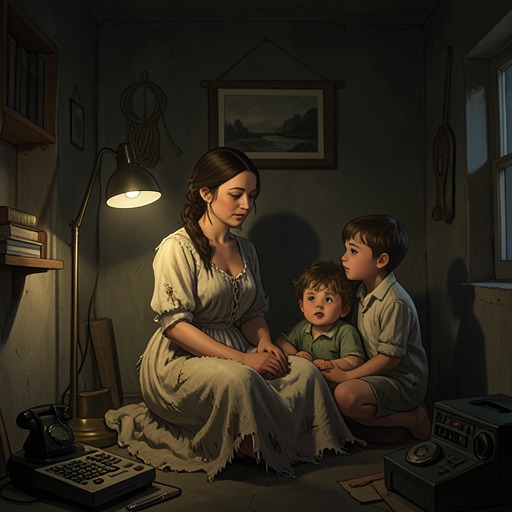
Their communication first grows through attention to immediate circumstances. When a lamp will not light, Marta names its condition in Spanish, trying several words and watching for Mike to follow. He eventually understands that the lamp is empty of oil. They fetch a five-gallon kerosene can, fill the lamp, and light it together. The small practical success matters because it is achieved through trial, repetition, and mutual observation rather than a shared vocabulary. Their delight in the lamp’s sudden glow briefly makes an ordinary task feel like a joint discovery.
Outside, they walk through a meadow where cactus, sunflowers, and red, white, and purple poppies grow. Mike senses that the sight saddens Marta and connects the untended field with the fertile land it had been when her husband was alive. This is an act of interpretation rather than a fact she has verbally conveyed to him: he reads her response to the place and recognizes a loss within the landscape. Their exchange shows both the reach and uncertainty of nonverbal understanding. Mike can be attentive to what matters to her, but he must infer what he cannot ask or confirm in words.
Stories, Laughter, and Emotional Recognition
Marta talks about her late husband and their life together, using words as well as gestures. She pantomimes the lung illness that killed him, joins her palms to convey that he was prayerful, and makes a fist to signify his strength. She also describes their good fortune with the fields, their difficulties with animals, their children, and her love of purple poppies. She does not stop to test whether Mike has understood. Even when she knows he has not, she continues as if he has, sustained by her faith in him and her desire to be understood.
Mike gradually overcomes his shyness about trying Spanish. He attempts words, accepts Marta’s laughter without withdrawing, and sometimes tries to make her laugh. When she catches the humor of one of his English remarks, he initially takes her laughter as evidence that the joke has crossed the language divide. He then recognizes something broader: she has caught his happiness. The moment shifts the measure of understanding from accurate translation to emotional response. Their feelings can reach each other even when the words do not.
Intimacy Beyond Words
As their relationship deepens, silence and physical closeness become further means of communication. At the creek, Marta explains the stream’s course from the hills toward a lake and warns through suggestive hand movements about a creature in the water. The scene lets language remain present but incomplete: she can describe the place in her own tongue, while Mike fills gaps through attention and imagination. Their playful closeness does not depend on a mutually spoken explanation. Later, Mike reflects that he does not need language for the happiness they share and that he feels understood in return. Their constant talk and chatter coexist with this reliance on tone, expression, and presence; the novel does not claim that words have become unnecessary in every circumstance.
This connection is also temporary, and both are aware of its limit. Mike is in the region because he is taking Rafo back to Texas at the request of Rafo’s father. Marta and Mike share time together, but neither their closeness nor their growing ease with one another can change the journey’s purpose. A sad look makes Mike recognize that they understand the same painful fact: this is only one day of a brief interval, and he will leave. Their happiness enables communication, but it cannot promise permanence.
Separation and the Limits of Understanding
When Mike finally tries to tell Marta that he is going and will never see her again, their earlier ease fails. He speaks quietly, hoping she will hear the sorrow in his voice, while Marta says things he assumes are meant to make him smile. He first believes they are talking past one another because she does not understand what he says. In retrospect, he sees that the two other occasions when she failed to understand him were also moments of pain: when he told her that the jacal had to be burned, and now as he tells her he must leave. In happiness, their words had seemed intelligible; in misery, they become meaningless to each other.
The ending does not turn their separation into a shared verbal explanation. Mike realizes that Marta is not laughing or crying and understands her as someone who knows how to take leave of things. They lie together in silence, and, when the ache becomes unbearable, he gets up and goes away. Communication beyond language has carried tenderness, practical cooperation, stories, and happiness, but it cannot make departure painless or guarantee that grief will be mutually expressed. Its significance lies in that distinction: the characters can genuinely meet without a common tongue, while the moment that demands an explanation exposes how little even their closest understanding can do to prevent loss.